



1. Formation & Distance
How did DEATĦ B¥ LØVE come together across the ocean between Pittsburgh and Łódź? What was the spark that turned file-sharing into a full band project?
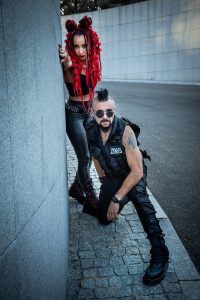
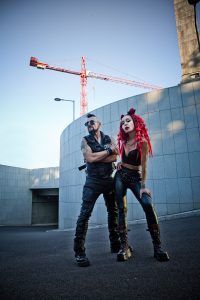
Peter: We first connected online through music. I had followed Inga’s work with Lorien, and later I remixed “Hide” for NUN Electro, another project in which she sang. At that moment Dichro, my previous band, had come to an unexpected end, and I was already sketching music that did not belong to that chapter. One of those sketches became “Strong Inside.” I sent it across the ocean, Inga answered with her voice and ideas, and suddenly the exchange felt less like a remix arrangement and more like the beginning of a language.
Inga: What made it a band was the ease of that conversation. We came from different histories, but emotionally we understood each other almost immediately. Peter did not treat my voice as something to place on top of a finished track; he left space for it to redirect the composition. We kept sending ideas back and forth, and each return changed the music. Then Peter came to Poland. In one extremely intense week we wrote and recorded, worked at Toya Studio in Łódź, filmed, took photographs, and began planning the visual world. It felt like six months compressed into seven days. By the end, DEATĦ B¥ LØVE was no longer an idea in a folder. It was a band.
2. The Creative Process
What were the biggest challenges and unexpected advantages of a year of digital collaboration and occasional travel, and how did it shape the final sound of 444?
Peter: The obvious challenge was not being able to react in the same room in real time. A small decision could require exporting stems, writing notes and waiting through the time difference. That forced us to become organized and very precise. The advantage was that nothing had to be accepted simply because the session clock was running. Each of us could live with an idea, dismantle it and return a stronger version. Distance slowed the mechanics but deepened the decisions.
Inga: It also protected intimacy. I could enter the most difficult emotions alone, without performing the process for another person, and send Peter the unfiltered result when it was ready. Pittsburgh brought steel, concrete and an industrial pulse; Poland brought historical melancholy, Slavic sensitivity and my own cultural memory. Those worlds had room to remain distinct before Peter joined them. That is why 444 does not sound like files stitched together. Its sharp edges survived, but so did its silence and vulnerability. The trips to Poland then gave the work a physical center and reminded us that the human chemistry behind the files was real.
3. The Title “444”
What is the significance of that number for you both, and how does it connect to guidance, survival, transformation, or spiritual tension?
Inga: For us, 444 carries the idea of protection, higher guidance and inner stability. I think of it as a sign that appears when you are moving through darkness but are not abandoned inside it. It is not a promise that suffering will disappear. It is a reminder that there may still be direction when you cannot yet see the destination.
Peter: That became personal because the record moves through trauma, manipulation, isolation, resistance and finally transformation. It does not deny despair, but it refuses to end there. The number gave a name to that movement toward survival, and eventually it became part of the band’s identity. There is also spiritual tension in it: are we receiving guidance from something beyond us, or discovering the strength that was already within us? The album leaves that question open.
4. Core Themes
How personal are the themes, and what experiences or family histories from each of your lives found their way into the songs?
Inga: They are intensely personal. The lyrics became pieces of my journey through therapy and toward harmony with myself. “Sellenno” grew from the need to give shape to buried childhood trauma and dissociation. Writing it was an exorcism of shadows, but also a realization that the joyful child inside me had not vanished. “I Don’t,” “Forest,” “Temros” and “Ziro” existed before Peter and already contained parts of my inner history; the other songs often began when our music released a particular memory or emotional truth in me. My Caucasian and Afghan heritage is present not as biography pasted onto the songs, but as instinct, scale, imagery and a respect for cultures and spiritual traditions that I absorbed from childhood.
Peter: My history enters differently. I was born in Poland, built my earliest musical identity in Łódź, and then lived in America for more than three decades. I carry both places: the melancholy and cultural memory of Poland, and the mechanical energy of American industrial music and Pittsburgh. I also brought decades of starting over, working inside other people’s visions, losing bands and rebuilding. So when the album speaks about survival and identity, I understand that not as an abstract concept but as a repeated act. I helped create the architecture in which Inga’s very personal story could remain exposed without becoming melodrama.
5. Inga’s Voice & Heritage
How much of your multicultural background and time fronting gothic and new-wave acts in Poland informs your vocal approach and the emotional worlds on 444?
Inga: All of it. My voice was shaped by years in Poland’s gothic, new-wave, electronic and ethno-folk worlds, including Lorien, NUN Electro and Habiarjan, but also by a family background in which the Caucasus meets Afghanistan. Oriental scales feel intuitive to me. I do not put them on like a costume; they arrive naturally in the way I bend a line, hold a note or use the voice as an instrument rather than a narrator. Those years also taught me that power does not require constant volume. On 444 I can be commanding, sensual, wounded, ritualistic or almost disembodied. In “Ziro” I sing in an invented, Arabic-sounding art language because ordinary words would have reduced the feeling. In other songs, clarity matters more. The spiritual charge comes from treating every vocal as an emotional event, not simply a melody that needs to be performed correctly.
6. Peter’s Background & Production
How did your history in the American and Polish dark-electronic underground inform the album while leaving room for trip-hop and Middle Eastern textures?
Peter: Blitzkrieg gave me the Polish gothic and post-punk foundation. Closterkeller and later The Electric Hellfire Club placed me in very different but equally intense environments, and years of electronic production taught me how rhythm and sound design can carry narrative. That history is why the album has a firm gothic-industrial skeleton: physical bass, repetition, pressure, guitars used for texture and beats that can move a room.
But I did not want to make a résumé in sound. I approached the record almost as a film composer, beginning with atmosphere and emotional purpose rather than asking whether a track was sufficiently industrial. Trip-hop gave us negative space, sensuality and slow tension. Inga’s scales and phrasing opened a door to Middle Eastern colors, acoustic instruments and ritual repetition. My job as producer was to build a frame strong enough that those elements could coexist without being flattened into one genre.
7. Genre & Cultural Collision
How did you blend gothic-industrial, darkwave, trip-hop, and Middle Eastern/world elements cohesively? Were there risky or revelatory moments?
Inga: We call it creative eclecticism. Influences are atoms, not templates: they collide with our own ideas until something else is formed. Cohesion comes from emotional intention. If an industrial rhythm, a duduk, a gothic bass line and a trip-hop space all express the same inner state, they belong together. If an element is there only because it sounds exotic or fashionable, it does not survive.
Peter: The risk was allowing some songs to leave the expected darkwave map completely. “Cosmic Power” folds trip-hop, country-like guitar color and a New Age or space-music atmosphere into the record. “Ziro” lets duduk, art language and ritual take precedence over conventional structure. Those choices could have fractured the album. Instead, they revealed its identity because Inga’s voice, the recurring themes of control and rebirth, and the production’s sense of tension connect everything. The revelation was that contrast became our glue.
8. Specific Tracks
What was the thinking behind the more Middle Eastern “Temros” and “Ziro” and the gothic-industrial “Sellenno,” “Strong Inside,” and “I Don’t”?
Inga: “Temros” and “Ziro” belong to a more ritual space. “Temros” circles an inner treasure that can inspire greatness but can also expose us to humiliation; its repetition is incantatory rather than narrative. “Ziro” is an initiation shaped by the myth of Inanna: identity is stripped away layer by layer so symbolic death can lead to transformation. Wojciech Lubertowicz’s duduk gives that descent breath, age and sorrow, while the invented language lets the voice move beyond literal explanation.
Peter: The other songs give the journey a harder physical frame. “Sellenno” uses a rapid, almost weapon-like riff and pounding electronics to confront trauma and dissociation. “Strong Inside” turns a direct industrial pulse into a paradox: walls may look like strength, but real resilience requires the courage to lower them. “I Don’t” combines gothic and industrial pressure with a trip-hop shadow to portray success as an isolating prison and refusal as liberation. The album needs both vocabularies. One descends through ritual and memory; the other breaks through resistance with machinery and force.
9. “Cosmic Power”
What was the vision for this tripped-out space-hop single, and where does it sit within the album’s movement from shadow toward transcendence?
Peter: We wanted “Cosmic Power” to feel seductive before it felt dangerous: suspended, spacious and almost narcotic, with a groove that draws you inward rather than attacking. That is where the space-hop character came from. The production promises expansion and limitless possibility, then gradually tightens around the listener.
Inga: Emotionally, it is about being offered power and discovering that the offer was manipulation. Belief becomes dependence, trust collapses and a void remains. But the song’s conclusion is not helplessness. It says that real power is not commanding the universe or surrendering your will to someone who claims to do so. It is reclaiming ownership of your inner world. In the album’s arc, that recognition is a necessary turn toward transcendence.
10. Live Presentation & Bridging Distance
How do you translate the cinematic quality of 444 to the stage, and how does multimedia help bridge the distance between you?
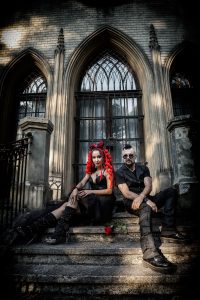
Peter: Onstage we remain a duo at the center, but Pam Simmons on guitar and Joe Palermo on drums give the electronics muscle, risk and human movement. I move between keyboards, bass and guitar, while synchronized video, projection and prepared arrangements expand the scale beyond four people. We do not try to reproduce the album like a museum object. We translate its pressure, atmosphere and emotional arc into a physical event.
Inga: The visuals reveal the architecture around the songs: decay, ritual, memory, altered identity and the collision of ancient and futuristic worlds. When travel makes it impossible for us to share a stage, holographic or multimedia appearances allow the audience to experience DEATĦ B¥ LØVE as the relationship between Peter and me rather than as one member plus an absent figure. It is a creative solution, not a replacement for being together. Nothing replaces eye contact and shared energy, but the technology has become part of our vocabulary and turns distance itself into material.
11. BlitzDay & Polish Roots
What does performing at Wooltura Club in Łódź for BlitzDay alongside MECHU and Shagreen mean to you?
Peter: For me it is deeply emotional. Blitzkrieg was one of the early Polish goth and darkwave bands and the beginning of my life in this music. Returning to Łódź with DEATĦ B¥ LØVE is not nostalgia for its own sake. It connects the young musician I was with the artist I became after decades in America. Wooltura and the independent scene represent the kind of place where music survives through commitment rather than fashion.
12. What Listeners Should Carry Away + The Future
What do you hope listeners carry from 444, and where does DEATĦ B¥ LØVE go next?
Inga: I hope listeners feel that trauma does not have to define an entire life. Darkness should not be romanticized, but neither should it be denied. Sometimes pain shows us what we failed to value, and the road to light passes directly through it. If someone hears their own struggle in these songs and feels less alone, or finds one small instruction for returning to themselves, then 444 has done something meaningful.
https://youtu.be/Mzaik7rWWDw?s
Peter: We are incredibly busy people. When we’re not remixing other artists or playing shows with other bands, we’re constantly creating something new.
One of the latest fruits of that creativity is “In Unity,” a collaboration with Wieloryb, the Polish industrial music producer and video artist. Sadly, there is a tragic story behind the release. Wieloryb passed away suddenly and unexpectedly, and our song became the final piece of music he ever worked on. The collaboration also produced an extraordinary post-apocalyptic music video and two remixes, all released in July.
On August 28, we are releasing another single, this time in Polish, titled “Królowa Świata” (“The Queen of the World”). It is accompanied by a new music video that we deliberately turned into a campy vampire love story—very gothic indeed.
We were also fortunate to have a special guest on the recording: Mario Usai of Clan of Xymox, who contributed the bass parts.
https://youtu.be/lXhQvXiq8Ns?s
Here is the link to music downloads:
https://www.filemail.com/d/xsj