


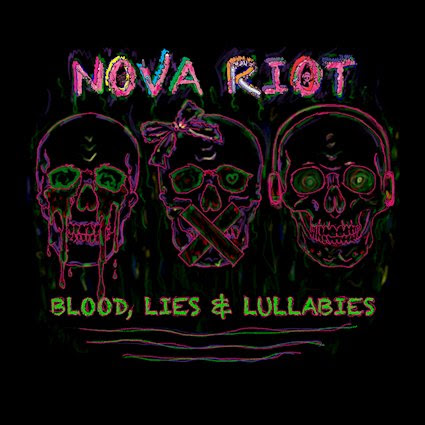
NOVA RIOT Tears Down the Genre Walls on Blood, Lies & Lullabies
The Oklahoma “bubblegum metal” outfit talks crushing riffs, candy-coated hooks, horror imagery, The Bunny The Bear, radio, critics, the Riot-verse, future touring and why listeners should leave their gatekeeping at the door
By James Lowe | KJAG Radio
For Nova Riot, contrast isn’t simply part of the sound.
It is the entire point.
Crushing, drop-tuned guitars collide with melodies designed to become lodged in your head. Horror imagery meets bright colors. Serious subjects live alongside theatrical fantasy. Dark atmospheres can suddenly give way to something playful, seductive or almost impossibly catchy.
The band has given that collision its own name: bubblegum metal.
And on Blood, Lies & Lullabies, released August 21 through Eclipse Records, Nova Riot isn’t asking permission from either side of the metal-versus-pop divide. The seven-track album includes “Haunting Me,” “Midnight Coven Crush,” “Casket,” “The Altar,” “Like I Meant It,” “Through The Storm” and “Sorry Mom.” Eclipse Records describes Nova Riot as emerging from Durant, Oklahoma, with Nova Ray on vocals, Orion on bass and Ares on lead guitar. (Eclipse Records – Metal Record Label)
The band’s attitude toward the whole experiment can probably be summarized in its own mantra:
Music with no apologies.
And after talking with Nova Riot at length about all 50 questions surrounding the new record, it becomes clear that the bright colors, masks, hooks and heaviness aren’t disconnected gimmicks. They are pieces of a deliberately constructed world.
Blood. Lies. Lullabies.
The album’s title is practically a mission statement.
For Nova, “Blood” represents the visceral side of the band—the heaviness, trauma and grit. “Lies” represents deception, heartbreak and the masks people wear. “Lullabies” represents the other extreme: infectious melodies and hooks capable of pulling listeners into the chaos.
“It captures the entire spectrum of our sound and storytelling,” Nova explained.
Orion sees an additional layer in the title. The three-part phrase was partially inspired by the familiar imagery of See No Evil, Hear No Evil and Speak No Evil, but twisted into something the band considered more uncomfortable, emotional and real.
That tension guided the record from its earliest stages.
Nova Riot wanted guitars with real low-end impact without sacrificing melodies that could survive completely on their own. Orion said the objective was never to let the heaviness overpower the hooks—or to let the pop sensibility neuter the guitars.
Instead, the two extremes needed room to coexist.
That philosophy helps explain why the band is so comfortable with the term bubblegum metal.
Nova defines it as modern, drop-tuned heavy music built around the same infectious songwriting instincts, bright aesthetics and memorable hooks associated with bubblegum pop.
“It’s loud, aggressive, and undeniably catchy,” she said.
The members aren’t claiming nobody has ever mixed pop and metal before. What matters to them is putting their own fingerprint on the combination.
Bubblegum Metal Wasn’t Invented in a Boardroom
Despite the carefully developed visual identity surrounding Nova Riot, Orion says the music itself developed naturally.
Before Nova Riot, Nova and Orion had worked together on a pop project. Before that, Orion says he spent 18 years in a nu-metal band.
Eventually, rather than separating those musical histories, they combined them.
“We just married the two with an identity to match,” Orion said.
That history also explains why Nova Riot can move comfortably between extremely accessible vocal hooks and significantly heavier instrumentation.
For Orion, contrast creates impact.
Sweet melodies sound sweeter when surrounded by aggressive guitars. Crushing riffs sound even heavier when they suddenly interrupt something melodic and inviting. Then the band’s visual identity amplifies the contrast again.
Nova Riot also rejects the notion that heavy music always needs to be grim-faced and monochromatic.
Nova admits that response hasn’t always been welcomed by traditionalists.
The band has heard everything from accusations that it doesn’t belong in metal to claims that Nova Riot sounds like some kind of “lab-created mutant” manufactured by record executives.
Rather than adjusting the music to satisfy those critics, the group built what Nova calls its own “Riot-verse.”
“We knew it might be difficult to get the metal community to accept us,” she said. “So we created our own little Riot-verse to live in.”
Fortunately, she added, that universe has begun finding its audience.
A Year of Writing, Rewriting and Knowing When to Stop
Blood, Lies & Lullabies took roughly a year to develop.
That doesn’t mean every song followed a neat progression from demo to finished master.
“Sorry Mom,” for example, existed in two different versions before the band settled on the final arrangement. “Casket” had already been recorded for more than a year before receiving a last-minute remix. Other songs were late additions, while some ideas were pulled from years of accumulated songwriting.
The track that finally revealed what the album could become was “Haunting Me.”
Nova remembers it as the moment the combination of crushing grooves, layered vocals and dark atmosphere locked into place.
“That was the blueprint,” she said.
For a completely new listener, however, Nova would point somewhere else.
Her choice for the ultimate Nova Riot introduction is “Midnight Coven Crush.”
It combines the band’s modern rock weight, immediate hooks, theatrical darkness and sense of fun in one package.
Another song evolved far more dramatically.
“The Altar” started closer to a straightforward heavy groove before additional voices and production layers transformed it into something Orion describes as much more cinematic.
He admits the finished direction initially required some adjustment even for the band itself.
Eventually, everybody fell in love with it.
Real Pain Inside a Fictional Universe
For all the theatricality, approximately half of Blood, Lies & Lullabies comes from real experience.
Nova describes the lyrical balance as roughly 50 percent personal and 50 percent fictional.
The emotions may come from actual trauma, relationships or moments in the members’ lives, but those emotions are frequently enlarged into horror stories, supernatural settings and larger-than-life characters.
Each track can therefore function like its own episode while remaining connected to recurring themes.
Transformation.
Confronting darkness.
Finding strength within chaos.
Sometimes the visual comes first. Nova might picture something such as a coven, an altar or a particular color and allow that image to trigger the lyrics.
Other times, the process works in reverse: something painfully personal becomes disguised inside fantasy.
And sometimes Nova and Orion simply begin with a subject they want to confront and build outward from there.
The common ingredient is contrast.
“Contrast is the foundational pillar of the band,” Nova said.
It isn’t merely musical. Sweet melodies sit above heavy guitars. Bright imagery surrounds darker ideas. The listener gets pulled toward one expectation before Nova Riot changes the rules.
Going to “The Altar” with The Bunny The Bear
One of the album’s most prominent collaborations arrives on “The Altar,” featuring The Bunny The Bear. Eclipse Records released the accompanying video ahead of the album, describing it as a dark ritual filmed within a decommissioned church. (Eclipse Records – Metal Record Label)
For Nova, the collaboration carried some additional emotional weight.
She had previously introduced Orion to music that had been important to her as a teenager. Without telling her exactly what he was planning, Orion reached out about a possible feature.
That allowed Nova to work with an artist she had grown up admiring.
The song itself was already substantially written before the collaboration happened.
As the arrangement developed, however, the band realized another vocal personality could push the song into a different emotional space.
The Bunny The Bear supplied exactly that.
Nova’s original vocals remained, but the additional parts injected what she describes as a frantic unpredictability into the track.
That mattered because Nova Riot doesn’t want guest musicians simply imitating what the band already does.
For Orion, a worthwhile collaboration should disrupt the song in the best possible way.
The same philosophy extends to other musicians appearing throughout the album. Their different backgrounds aren’t something Nova Riot wants hidden; those differences are the reason to invite them.
Lyrically, “The Altar” examines sacrifice—not necessarily in the horror-movie sense suggested by the visual presentation, but in terms of what someone is willing to surrender, survive or endure in order to grow or protect something important.
Again, there is Nova Riot’s favorite trick:
The image draws you toward one interpretation.
The song opens another.
Enter the “Midnight Coven Crush”
Then there is “Midnight Coven Crush.”
Even the title sounds like somebody combined a teenage romance, an occult horror film and a neon sign.
That is basically the idea.
Nova describes the song as the story of being hopelessly attracted to someone magnetic, dangerous and chaotic—knowing you’re walking directly into trouble and enjoying the experience anyway.
And yes, there is another layer to the title.
In one of the interview’s more memorable revelations, Nova acknowledged that “Midnight Coven Crush” also carries an intentionally sexual double meaning referring to female anatomy.
Subtlety has apparently never been mandatory inside the Riot-verse.
The song’s official visual extends those themes considerably. Eclipse Records describes the video as combining the band’s candy-colored visual identity with horror imagery and a story centered on autonomy and reclaiming power. It was directed by Nova Ray. (Eclipse Records – Metal Record Label)
For the band, horror, fantasy, supernatural imagery and theatricality aren’t accessories attached after the songs are finished.
They are part of the composition process.
Orion says the group will sometimes begin picturing camera angles, lighting, colors and entire scenes as soon as a riff or chorus exists.
Those ideas aren’t sacred. Something discovered on the video set can still send the finished production in an entirely different direction.
What matters is that the audio and visuals feel like they belong to the same world.
“Horror and rock/metal go hand in hand,” Orion said.
How Nova Riot Builds a Song
There is no single formula, although many songs begin with Orion.
A guitar groove or melody establishes the initial movement. Nova then begins constructing vocal ideas around it while the band builds out the heavier foundation.
But years of working together have made the process fluid.
Sometimes the melody starts everything.
Sometimes it is a riff.
Sometimes everybody is in the room and an idea happens spontaneously.
Nova says she and Orion have been writing together long enough that they have probably written songs “just about every way you can possibly imagine.”
Writing a memorable chorus against heavy instrumentation takes discipline more than difficulty.
The trick, Nova says, is getting unnecessary clutter out of the way so the melody can breathe.
She credits Orion with knowing how to create riffs that remain simple enough to maintain the groove while still sounding heavy, while Ares can inject flashes of chaos, color and lead work before everything drops back into place.
And the band’s influences don’t stop anywhere near metal.
Orion points to classic synth-pop, modern dark-pop production, cinematic film scores and classic hard rock as important ingredients.
The actual studio process, perhaps surprisingly, wasn’t dominated by endless experimentation.
Orion handled pre-production before material moved into the next production stages, and the core structures generally remained recognizable. Some arrangements changed, but this wasn’t an album assembled through hundreds of random studio experiments.
There were, however, moments when ideas initially sounded ridiculous.
Orion recalls Ares making production suggestions that seemed strange until they revealed the climactic moment a song needed.
Then there was the moment Nova decided one particular song absolutely needed a scream.
And she was going to be the one to do it.
Watching her develop that additional vocal side became part of the album’s evolution.
Knowing when to stop was equally important.
Orion’s test is straightforward: if adding another element begins hurting the hook, while removing an element weakens the impact, the song is finished.
“When it hits you in the gut and gets stuck in your head instantly, it’s done,” he said.
The Riot-Verse Is Bigger Than the Record
Nova Riot’s visual presentation is not marketing applied after the fact.
Nova considers the fashion, masks, colors, artwork and videos equally important to the audio.
The goal from the beginning was to create a place that seemed dangerous—but fun.
“We want Nova Riot to feel like a universe you step into,” she said, “complete with its own lore, aesthetic, characters, and energy.”
The bright presentation can occasionally work against the band with people who decide what Nova Riot must sound like before hearing a note.
Orion is fine with that.
The surprise is part of the fun.
Someone sees the colors, theatricality and pop presentation, expects something soft, and then the down-tuned guitars arrive.
“The moment the first drop hits, any assumption that we’re soft gets obliterated,” he said.
Nova describes that reversal as one of her favorite parts of the project: lure someone in with a glossy visual, then flatten the expectation with guitars and drums.
Genre Rules, Gatekeepers and a Generation Raised on Shuffle
Does that approach mean today’s listeners are more willing to accept genre hybrids?
Orion isn’t convinced the world has changed as dramatically as people sometimes claim.
Every generation has favorites. Every genre develops rules and expectations. Audiences ultimately gravitate toward artists who stimulate them and provide something worth caring about.
Nova does see a difference among younger listeners, however.
A generation that grew up with playlists and shuffle buttons may hear metal, hip-hop, electronic music and pop within the same hour.
Those listeners haven’t necessarily been trained to see genre boundaries as walls.
When asked what heavy music could use more of, Orion’s answer sounded very much like a Nova Riot manifesto:
Fun. Personality. Huge hooks. Aggression. And the willingness to combine all of them.
Nova also wants to destroy the assumption that colorful or melodic automatically means simple.
Behind the accessible surface, she argues, are heavy tones, precise playing and genuine emotional weight.
Finding a Home at Eclipse Records
Nova Riot’s relationship with Eclipse Records came from what Orion describes as a shared understanding of the band’s creative and commercial possibilities.
Eclipse officially announced its worldwide deal with Nova Riot in April 2026, ahead of the debut album. (Eclipse Records – Metal Record Label)
For Orion, the important part was that the label understood the hybrid immediately rather than trying to force the band toward one side of its identity.
The relationship also gives Nova Riot infrastructure capable of taking the record beyond its existing audience.
That includes something the band remains particularly passionate about:
radio.
Radio Still Matters
For Nova, hearing one of these songs coming through an actual radio station remains surreal.
Streaming can put music everywhere instantly, but radio represents a shared experience—someone behind a microphone choosing a song and putting it in front of an audience.
Orion strongly believes that role continues to matter.
“Radio curates a direct human connection through DJs and programmers that algorithms simply cannot replicate,” he said.
There is another reason he might be slightly biased: Orion notes that, when his schedule permits, he also works as an FM radio personality.
The band has consequently made direct relationships with stations part of this album campaign. Nova Riot recorded station IDs for outlets supporting the record and has made itself available for interviews.
Nova sees those relationships as essential.
The programmers, hosts and stations that still devote time to rock and metal are actively championing the music, and she believes bands should reciprocate that support.
What Happens When Nova Riot Goes Live?
The next major challenge is taking this universe out of headphones and onto stages.
Nova Riot doesn’t want to walk into clubs and simply perform the album in front of a banner.
The objective is a dynamic, theatrical live production that looks like the music sounds.
There is, however, a practical consideration.
Money.
Orion is candid that the live show has to make financial sense. The band would rather wait until it can move enough tickets to justify creating the experience fans deserve than rush onto the road with a stripped-down version that doesn’t represent the vision.
When the time comes, Nova is particularly excited about playing “Midnight Coven Crush” and “The Altar.”
Both songs have the movement and crowd energy she believes can explode in a live environment.
And if money were completely irrelevant?
Nova’s dream production includes towering video walls, custom sets, synchronized pyro, horror-fantasy effects and interactive storytelling.
Her description is considerably better:
“Basically if a glitter bomb full of hot pink and evil clowns went off at an In This Moment concert!”
That sounds about right.
More Videos, Another Song and Even a Film
The August album release doesn’t represent the end of the Blood, Lies & Lullabies campaign.
Nova Riot says additional videos, visual material and behind-the-scenes content are planned as the band continues expanding the album’s universe.
There is even another song that didn’t make the final seven-track record because it didn’t fit sonically.
That doesn’t mean it is dead.
The band has left open the possibility that it could eventually surface as its own release.
And despite focusing on the current record, Nova Riot has already begun moving toward whatever follows it.
New riffs exist.
Concepts are being developed.
Higher-profile collaborations are being discussed.
Most significantly, Orion says studio time is already booked for the next album.
But music isn’t the only next frontier.
A year from now, Orion would like to see Nova Riot touring heavily, appearing at festivals, growing internationally, competing on the rock charts and expanding into film.
That last goal is already moving from theory toward reality.
The band is preparing to shoot its first short film.
Considering how much cinematic thinking already goes into Nova Riot’s songwriting and videos, the move feels less like a side project than an inevitable extension of the Riot-verse.
Blood, Lies, Lullabies — and No Apologies
After all the genre arguments, production discussions, masks, guest appearances, videos and future ambitions, Nova Riot’s desired outcome for Blood, Lies & Lullabies is remarkably straightforward.
Nova wants listeners to finish the album feeling energized, empowered and entertained.
Not exhausted by a concept.
Not impressed by how many genres were combined.
Not concerned with whether some imaginary metal rulebook was followed correctly.
She wants the record to feel like a ride worth immediately taking again.
And when someone encounters the words Nova Riot and bubblegum metal for the first time, she has one final piece of advice before they hit play:
“Leave your gatekeeping at the door, crank the volume all the way up, and prepare to have the heaviest hooks of your life stuck in your head!!!”
That may be the best possible introduction to Blood, Lies & Lullabies.
Because Nova Riot isn’t particularly interested in deciding whether bubblegum belongs in metal.
They’ve already stuck it there.
And now they’re daring everybody else to deal with it.
Nova Riot’s Blood, Lies & Lullabies is available now via Eclipse Records. The album was released August 21, 2026, and includes the singles “The Altar” featuring The Bunny The Bear and “Midnight Coven Crush.” (Apple Music – Web Player)
Nova Riot at Eclipse Records
Watch “The Altar”
Watch “Midnight Coven Crush”