


NTERVIEW QUESTIONS: THE SPEED OF SOUND
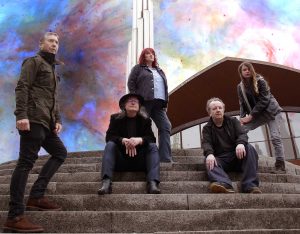
Topic: ‘SS-100-X’ & A Cornucopia Trilogy
Artist: The Speed of Sound
Release: ‘A Cornucopia: Minerva, Victory, Bounty’ (Big Stir Records)
SECTION 1: THE SINGLE – “SS-100-X”
Let’s dive right into the striking new single “SS-100-X.” How did JFK’s assassination—and the mystery surrounding it—inspire this track? There were conspiracy theories before then, but the Kennedy assassination was probably the one that spawned multiple theories that went mainstream, and it has so much longevity. Given the number of lone-gunmen that kill people in the US every week it seems bizarre that people think it couldn’t happen to a president and instead it had to be a grand conspiracy to match the stature of the victim. People want to be reassured that everything is planned; that ‘everything happens for a reason’ phrase underlies a lot of conspiracy thinking, there seems to be no belief in random events and chance.
The video’s use of AI-generated imagery is provocative. How did you approach blending historical fact and speculative visuals in a way that fits this “post-fact” world? I threw my own post-truth red herring into the mix by including A.I pictures of Marilyn Monroe at JFK’s funeral, despite her having already been dead for two years, impossible nonsense of course but it fitted so well with the rest of the visuals. Blending a few real images and diagrams with the A.I is a standard misinformation approach, lending the fake more authenticity.
There’s a fascinating anecdote about your view from a 5th-floor Portuguese hotel being identical to Oswald’s. Did that eerie synchronicity help shape the lyrics or the emotional tone of the song? The entire first verse is exactly as it happened, it took a few moments to realise the view was the same as LHO’s because of the Ground Floor/First Floor counting methods (my balcony was on the 5th, but that is the 6th with US counting). The Lincoln was driving away from me, slowly with the roof down, despite it being brown not black it and there not being a pill box hat it was very familiar. I had built a writer’s-nest (rather than a sniper’s-nest) on the balcony and was already working on another song, but I put that aside and the verses poured straight out of the pen and even then I knew it needed a straightforward uncomplicated feel to the music.
You describe “SS-100-X” as part of a larger cultural breakdown in how we define truth. Do you feel music still has the power to confront conspiracy and misinformation head-on? I do; its a catastrophe that facts have become a matter of choice and proof or evidence no longer carry any weight. That a provably incorrect opinion apparently deserves as much consideration as peer reviewed science is utterly nonsensical. Art is inescapably political and any voices that say music shouldn’t be political are merely being hypocritical about freedom of speech, in a similar way artists that ignore politics are making a political statement by omission.
SECTION 2: THE TRILOGY – MINERVA, VICTORY, BOUNTY
Congratulations on 35 years! Releasing a triple-album trilogy to mark the anniversary is an audacious move. What was the original spark behind A Cornucopia? Each album has its own personality—Minerva is belligerent, Victory is a manifesto, Bounty is the harvest. What made you divide the creative expression this way instead of delivering one single album? I’d already started working on what became ‘Cornucopia’ while we were still recording ‘Museum Of Tomorrow’, and then covid arrived, delaying the release of ‘Museum’ and causing big a backlog in recording. By the time we were able to rehearse again I already had well over 30 songs to try out, plus half a dozen we’d made a start on, so the trinity idea grew from there. Once I started thinking in 3s the goddess/personalities idea arrived – goddesses always hang out in threes. To release them separately would have taken far too long and prevent me thinking beyond these songs for years.
How did your songwriting evolve across the three records? Were any tracks written back-to-back or did they span different writing seasons? I use a paper notebook and jot down titles and ideas as I think of them and leave them to percolate in the subconscious so when I get time and mental space I can bring them out more or less fully formed. About half these songs were written within a week on that Portuguese hotel balcony, 3 or 4 a day. The rest dripped in over the following year or so, lyrics first then adding the music once the song can decide where it wants to go.
You’ve said these albums are anti-conveyor-belt singles. In an age of playlists and bite-sized releases, what does long-form music offer that nothing else can? Albums should be like building a set list for a gig, with a planned trajectory and shape, with tension build-and-release and shifting feel, tempo and key, intentional placement one song after another pulling the listener in a direction where listening is an experience. An auto (or random) generated playlist simply can’t do that in a consistent way. I listen to albums and want to make music for other people that like albums.
Tracks like “West Wind,” “The Great Acceleration,” and “Underground” each have distinct identities. How did you approach sequencing the songs to maintain flow across such a massive body of work? I’d already planned out the track sequencing for all three discs before we started recording, the physical time limits on each side of vinyl was a factor, maximising usage on all the six sides and treating each of those sections as a separate set.
SECTION 3: SOUND & STYLE
Your sound pulls from punk, 60s psychedelia, garage rock, and more. With so many comparisons—The B-52s, Television, Blondie—what do you feel is uniquely Speed of Sound? There is a thing we do a lot which has us playing at different speeds, for example in West Wind the bass and guitars are 225bpm and the drums are half that speed to keep one of the tent pegs nailed down and stop it blowing away. A mix of ephemeral vocals and brute force instrumentation, the ability to float and crunch at the same time, I don’t think anyone else does that the way we do.
Ann-Marie’s vocals and background in folk and opera bring a rare range to the group. How has her presence shaped the band’s evolution since 2015? We had dual male/female vocals way back in 1989 and after Christine left it took that long to find the right voice to blend with mine, so initially it took us back to the start line, filling out the sound immensely (and adding a 2nd guitar on some songs live too). She has a great voice to write for.
John, your guitar playing blends lead and rhythm seamlessly. How did that style develop and how does it serve the band’s layered sonic approach? I’m self taught and learned a lot early on by improvising with people more experienced than me. Guitar is a life-long-learning thing and I was never really driven to play other people’s stuff, I wanted to experiment and find my own style, which is what I’ve been doing since first picking up a guitar. The previous album ‘Museum Of Tomorrow’ was written to be played live, so there isn’t as much layering as there is on ‘Cornucopia’, with this I really wanted to push what we could do in the studio rather than recreate a live performance.
Can you tell us about the addition of Henry (your son) on keys—what does he bring to the group both musically and personally? We hadn’t had a keyboard player before Henry and he really broadened the sound; he doesn’t occupy the same sonic space as guitar. He’s interested in film music and jazz and has trained as an improviser so he had the right skill set. He thinks in Standard Notation and I don’t use SN at all, but despite that his approach is very compatible and he’s good fun to work with.
One of your strengths is maintaining cohesion while still taking creative risks. What’s your secret to staying adventurous without losing your core identity? Recognise what makes your own style unique and apply that to the style the song wants, rather than thinking “ok lets do a disco one” and importing that whole approach.
SECTION 4: PHILOSOPHY & LEGACY
The lyrics across A Cornucopia are rich with metaphor, history, and commentary. How do you balance being thought-provoking without becoming heavy-handed? I like to approach things a bit obliquely and to keep a lightness in they lyrics with a touch of humour.
You’ve called this project a “celebration of all unheard underground music and the whole counterculture itself.” Why was it important to honor that legacy? Years ago I watched an interview with Vivienne Westwood and they asked her why haute couture was important, she couldn’t comprehend the question and just spluttered; I’m not quite doing that, but; globally we have just three major record labels that have zero interest in music, only in shifting ‘product’. If you want interesting music you will not find it there.
Looking back to 1989 and your earliest days in Manchester, what has surprised you most about your journey—artistically or personally? The thought that people could be satisfied with A.I created music with no human input isn’t just surprising its quite disorientating. The whole passive consumption thing is the opposite of the punk ethos of make your own art and express yourself. That feels really alien.
What do you hope new listeners take away from the trilogy, and what do longtime fans rediscover in it? We want to make music an experience in itself rather than a mere muzak accompaniment to doing something else, music should be the main event, and hopefully listeners will discover music that makes them think a bit as well as groove.
If you could go back to The Speed of Sound’s early gigs and whisper one thing in your own ear, what would it be? “You’re on the right track” but the arrogance of youth meant I already felt that anyway!
SECTION 5: WHAT’S NEXT
Now that this trilogy is out in the world, what comes next? Touring, videos, another conceptual project? I’ve done six albums in five years, with 24 videos for the ‘Cornucopia’ project, so I’ll be taking some time to reset before setting about the next one, there are already a stack of possible titles and ideas in the notebook but I need to let them stew for a while before seeing what has brewed. It’ll be ‘a while’ but watch this space.
For fans discovering you via ‘SS-100-X’ or ‘Permafrost’, where would you suggest they start in the Cornucopia journey—Minerva, Victory, or Bounty? The three aren’t actually in a rigid order as its not a linear story, its more that they’re linked thematically, so whichever one has the most appealing titles is the best entry point: Overall Minerva has more drive, Victory experiments more and Bounty just does what it wants.
Where can listeners support you most directly—Bandcamp, physical media, social media, or live shows? The whole Social Media thing has gone ‘a bit fluid’; Facebook-feeds are a conveyor belt of A.I slop and bots posting to each other, which will be much worse when Meta get their A.I advertising thing going. Since Twitter’s downfall everything else has splintered and its not possible to have an active presence on everything, it feels like people are simply deciding not to use it anymore so I do wonder what is going to happen next with that. The ‘shop page’ on our website (thespeedofsounduk.com) is sorted by format (Vinyl/CD/Downlad) and is linked to our bandcamp and also Big Stir Records’ bandcamp. Buying the music is the best way to support any independent artist.
Some video:
SS-100-X – https://youtu.be/-LvLPt9VfD0
The Great Acceleration – https://youtu.be/LCGSCo9xj3g
Permafrost – https://youtu.be/yWW4-wiQsEs
The Melancholy Rose – https://youtu.be/ZlYaSYP9m00