


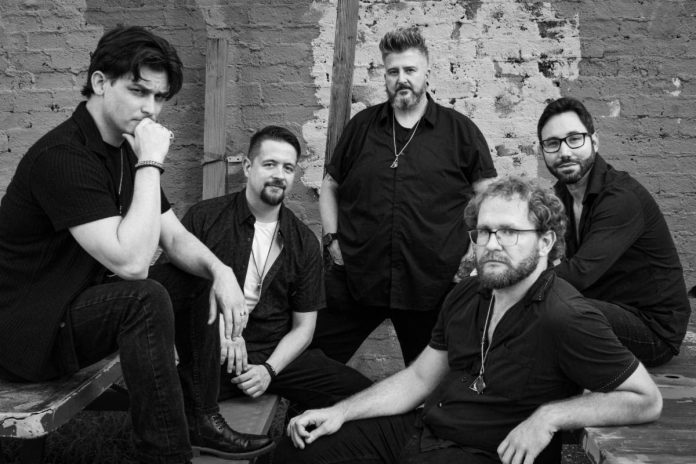
Sight of Theia Takes Listeners Into the Abyss With The Great Dreamer
By KJAGRadio.com/The Mic
Sight of Theia is taking progressive metal into the depths of cosmic horror with The Great Dreamer, an ambitious concept album built around astronauts, the unknown reaches of space, and an encounter with one of horror’s most enduring entities: Cthulhu.
But the story behind the album is almost as fascinating as the story contained within it.
Founded by guitarist and songwriter Alex Buhlig, Sight of Theia has undergone several lineup changes since its early days as a largely instrumental, DIY project. The band’s current lineup—Buhlig, vocalist Haden Rider, guitarist Charles, bassist Bill Pritchard, and drummer Ricky Shenkmen—represents a significant evolution in the band’s approach to songwriting, arrangement and production.
As Buhlig explains, the early version of Sight of Theia recorded the Red Sun EP before eventually dissolving. The band’s eventual reconstruction brought together Ricky, Charles and Bill, with the new lineup placing considerably more emphasis on arrangement and production.
“For me it was the arrangements,” Buhlig says when describing what ultimately clicked with the current lineup.
That evolution would eventually lead to The Great Dreamer.
The band’s Lighthouse EP became an important transitional point, marking the first release with the new lineup and the first attempt at the band’s new creative workflow. The song “Black Magic” generated attention at local shows and ultimately inspired elements of the material that would become The Great Dreamer.
Buhlig also identifies that period as the point where Meshuggah and modern djent influences began becoming particularly apparent in the band’s sound.
From Instrumental Concept to Vocal-Driven Cosmic Horror
One of the most interesting twists in the creation of The Great Dreamer came when Haden Rider entered the picture.
The album had originally been conceived as an instrumental project. Rider was introduced to Sight of Theia by bassist Bill Pritchard, with whom he was playing a weekly jazz gig.
The musical connection might seem unexpected at first.
Rider was coming from a musical theater background and was singing in a very different style. But underneath that theatrical background was a longstanding love of progressive metal.
When Pritchard asked Rider if he had ever tried singing metal, the answer was no—but Rider had been a progressive metal fan since high school.
His theater background had also given him experience with a wide range of vocal techniques, including his role as Jesus in Jesus Christ Superstar, which provided his first real taste of heavy rock vocals.
Once Rider heard Sight of Theia’s material, however, the decision was easy.
“I was all in,” he recalls.
His arrival transformed what had been an instrumental project into something with an entirely different vocal dimension.
Building the Story After the Music
The cosmic-horror narrative behind The Great Dreamer was not necessarily the starting point.
According to Buhlig, the initial inspiration came from the science-fiction novel Children of Time, which dealt with humanity’s attempts to colonize space. That concept eventually helped inspire “Children of the Uplift.”
As the band assembled songs and developed the album’s track sequence, the beginnings of a larger narrative started to emerge.
Interestingly, the story came after the music.
“The narrative developed after the sequence of songs was set,” Buhlig explains.
The band noticed that the album naturally moved from relatively upbeat and energetic material toward something increasingly ominous, meditative and psychedelic.
That progression provided the foundation for the album’s narrative.
In other words, The Great Dreamer didn’t simply have a story imposed upon it. The music itself helped reveal the story.
That approach also helped establish the album’s cosmic-horror atmosphere.
Buhlig describes some of the album’s heavy, odd-time passages as having an ominous quality. The title track, in particular, eventually took on the feeling of attempting to summon something beyond human understanding.
“The Great Dreamer” became, in Buhlig’s words, an attempt to summon anotherworldly entity—and eventually that entity became Cthulhu.
Meshuggah, Leprous, Mastodon and the Sound of the Unknown
Sight of Theia’s music exists within the broad territory of progressive metal, but the band’s influences are diverse.
The group has been compared to Mastodon, Leprous and Meshuggah, and Buhlig sees elements of all three within the band’s current sound.
Of those comparisons, he considers earlier Leprous perhaps the closest sonic reference point, while Mastodon’s abundance of riffs and Meshuggah’s rhythmic approach also play important roles.
The result is music that doesn’t stay in one place for very long.
The Great Dreamer moves between crushing guitar work, complex rhythmic passages, atmospheric textures, progressive arrangements and melodic sections.
For Buhlig, the key is balance.
“Too much of anything gets boring,” he explains.
That philosophy is reflected in the album’s use of tension and release. Rather than maintaining maximum intensity throughout, Sight of Theia allows different musical elements to breathe.
The logic is simple: if everything is at a 10 all the time, eventually nothing feels like a 10.
What Happens When Vocals Enter the Picture?
Because The Great Dreamer began life as an instrumental album, adding vocals presented an unusual creative challenge.
By the time Rider joined the project, the instrumental mixes had already been completed and paid for.
That meant the vocalist was essentially working within an established musical framework.
Rather than viewing that limitation as a problem, however, the band discovered something exciting in the process.
Buhlig says hearing his guitar parts recontextualized by Rider’s vocals was one of the best aspects of recording the album.
Rider approached the material with a similar philosophy.
Because the album already had a conceptual framework and a loose chronological story, he was able to approach the songs almost like scenes in a musical—a natural fit given his theater background.
His process involved repeatedly listening to each song until a chorus began to emerge, then building melodies and lyrics around that central idea.
The goal wasn’t to overpower the instrumentation.
Instead, Rider wanted the vocals to feel like they belonged inside the existing arrangements.
“Because the instrumentals were already so strong,” he explains, “I was careful to make sure every vocal part felt like it belonged there.”
That collaborative approach became an important part of the finished album.
The People Behind the Production
The ambitious sound of The Great Dreamer was also shaped by a larger production team.
Christoffer Borg handled mixing and mastering, while John Douglass worked on drums, Alex Parra contributed guitar and bass editing, Corey Bautista handled vocals, and Sara Slick created the artwork.
For Buhlig, each person brought something different to the project.
Borg, in particular, had to adapt when the band returned after the instrumental mixes had already been completed with essentially one major message:
“Actually, we’re not done yet.”
Buhlig credits Borg with balancing the album’s competing melodies so that individual elements never felt lost.
Douglass, Parra and Bautista brought efficiency and expertise to their respective areas, helping the band avoid several production headaches.
Artwork was another important component.
Slick has worked with the project for much of its existence, giving her a deep understanding of the band’s thematic direction and allowing the visual identity to develop alongside the music.
Making Difficult Music Work as a Band
The rhythmic foundation of The Great Dreamer also reveals something about the personalities inside Sight of Theia.
Asked how Ricky Shenkmen and Bill Pritchard approached the grooves and dynamics of such a progressive record, Shenkmen offers a characteristically blunt answer:
“The truth is we didn’t do what the question asked.”
Instead, the process was more chaotic—and perhaps more appropriate for a progressive metal band.
Buhlig would create rhythm parts, Shenkmen would attempt to make them even harder to play, and Pritchard would then have to learn them.
The exception was Pritchard’s solo on “Mad Hatter,” which he wrote himself.
Despite the complexity of the music, Pritchard says he and Shenkmen have developed a natural rhythmic connection.
He describes Shenkmen’s playing as clear and precise, making it easy for him to find the drummer’s position within the music.
The two musicians also naturally feel the groove in the same place and play on the same side of the beat.
Perhaps most importantly, Pritchard says they have never really needed to discuss it.
They simply lock in.
Two Guitars, One Vision
With Buhlig handling the bulk of the writing and arrangements, guitarist Charles has a somewhat different role within the creative process.
Buhlig, according to Charles, is the mastermind behind most of the material, but he frequently leaves openings for his bandmate to contribute.
Sometimes the instruction is essentially: do whatever you want here.
Those gaps provide Charles with room to add his own voice.
He contributes additional guitar parts, ambiance and clean lines where appropriate, while also experimenting with different tones and improvisational ideas during studio sessions.
That collaborative approach means the songs aren’t necessarily frozen once Buhlig writes them.
The band continues developing and refining them during rehearsals.
If a riff needs to change, they work it out together.
The result is a songwriting process that combines a central creative vision with contributions from the entire lineup.
Taking The Great Dreamer to the Stage
The next challenge for Sight of Theia is bringing The Great Dreamer into the live environment.
Buhlig says the band hopes to play a significant number of shows supporting the release.
The group has already become increasingly tight as a live unit, while Rider continues settling into his role as the band’s vocalist.
For a concept album this ambitious, the live presentation could become an important part of the overall experience.
Rather than simply reproducing the record, Sight of Theia has an opportunity to translate its cosmic-horror atmosphere into a live setting.
For now, though, the band’s focus is on getting the material in front of audiences.
There’s More Coming
While The Great Dreamer represents a major chapter for Sight of Theia, it apparently isn’t the end of the story.
The band would like to tour the material and expand its audience.
And there is already more music waiting in the wings.
Buhlig reveals that the group has an entire album’s worth of demos that could eventually be recorded.
So while The Great Dreamer may take listeners into the unknown, Sight of Theia isn’t planning on disappearing into the darkness anytime soon.
There is more music ahead.
For fans of progressive metal, cosmic horror, intricate rhythms and music that rewards repeated listening, The Great Dreamer could be an intriguing journey into unfamiliar territory.
And perhaps that’s exactly where Sight of Theia wants you.
Final Thoughts
What makes The Great Dreamer particularly interesting is that the album’s concept wasn’t simply constructed from the beginning and then translated into music.
Instead, the music appears to have revealed its own story.
The progression from energetic material to darker, psychedelic and increasingly ominous territory gave Sight of Theia the framework for its cosmic-horror narrative. Then Haden Rider’s arrival added another dimension, bringing theatrical experience and a passion for progressive metal into an album that had originally existed without a vocalist.
The result is a record shaped by experimentation, collaboration and a willingness to let the music evolve.
As Sight of Theia looks toward live performances, touring opportunities and another album’s worth of demos, The Great Dreamer appears less like a conclusion and more like the beginning of the band’s next chapter.
The Great Dreamer is scheduled for release September 4.
Interview conducted for KJAGRadio.com/The Mic.