


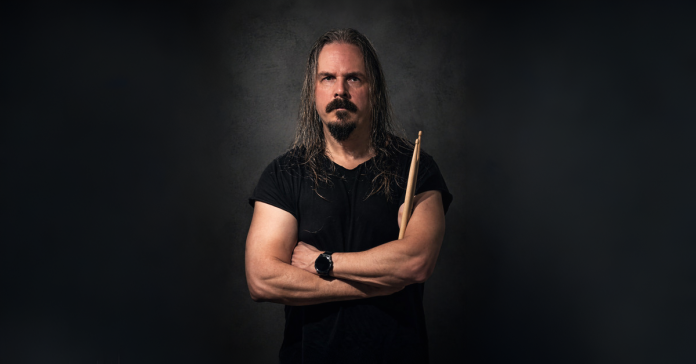
Progressive metal has always thrived in the space between technical brilliance and emotional intensity — and on Scorched, Bjarte K. Helland pushes both to their absolute limits.
Set for release on May 2, 2026, Scorched marks a heavier, rawer evolution for the Norwegian drummer, composer, and progressive architect. Drawing influence from legendary acts like Liquid Tension Experiment, Planet X, and Animals as Leaders, the EP combines crushing rhythms, cinematic atmosphere, intricate musicianship, and deeply personal themes into a project that feels both technically fearless and emotionally grounded.
Unlike traditional progressive metal records driven primarily by guitar riffs, Scorched begins from behind the drum kit — with rhythm and groove shaping the DNA of every composition. The result is a dynamic listening experience filled with tension, release, chaos, melody, and moments of breathtaking precision.
Featuring collaborations with world-class musicians including legendary bassist Billy Sheehan, the EP explores themes of personal transformation, societal instability, and rebuilding through destruction — all without relying on lyrics to tell the story.
In this exclusive interview with KJAGRadio.com, Bjarte K. Helland discusses the creative vision behind Scorched, composing from a drummer’s perspective, balancing complexity with emotion, and why progressive music still rewards listeners willing to dive deeper beneath the surface.
BJARTE K. HELLAND — SCORCHED
 ABOUT THE EP
-
Your new EP Scorched drops May 2, 2026—what does this release represent for you creatively compared to your previous work?
With this release, I wanted to lean more into a metal direction compared to my previous EP, Maniae (2021). That one was more of a blend between fusion and progressive metal, with a cleaner overall sound.
For Scorched, I aimed for something rawer and more punchy. Recording and mixing my own drums also gave me a lot more control, and allowed me to shape the sound exactly the way I wanted.
-
The title Scorched carries a lot of weight—what’s the deeper meaning behind it?
It has a dual meaning. One aspect relates to the world we’re living in and how it’s changed over the past decade, from a rules-based order to something closer to a “might makes right” mentality. Alliances feel more fragile, and things we took for granted, like security and freedom of speech, are increasingly being challenged. In a way, it can feel like we’re slowly scorching everything we once relied on.
The second meaning is more personal. Sometimes you have to “scorch” your own demons in order to move forward, to break things down and rebuild yourself.
-
You’ve described this as a heavier evolution—what pushed you in that direction sonically?
In my younger years, especially as a teenager, I listened almost exclusively to metal. Like Iron Maiden, Metallica, Testament, Slayer, Pantera. And I was pretty one-dimensional for a while, not at all open for anything else.
Even though I now also enjoy fusion, funk, and other styles, I felt like leaning back toward my musical roots, just approaching it from a much more progressive angle.
 DRUM-DRIVEN COMPOSITION
-
Scorched flips the traditional progressive metal formula by putting drums at the center—what inspired you to build songs from the kit outward?
First of all, because I’m a drummer. I’ve always been drawn to drummers who push rhythmic boundaries and make odd time signatures feel natural. Making something like 17/16 feel almost like a regular groove is something I spend a lot of time on. It’s that feeling where you sense something unusual is happening in the rhythm, but you can’t quite put your finger on it.
I often start by building parts around the rhythm or groove, while gradually shaping a melody or riff in my head. That said, it’s not a strict rule, sometimes a melody or riff comes first. I don’t sit down and map out the entire song from start to finish on the drum kit.
-
How does composing from a drummer’s perspective change the way songs develop compared to guitar-driven writing?
That’s a tough question, because I can really only answer from my own perspective, as a drummer. I do think composing from a drummer’s point of view tends to work best in more progressive styles of music. It might be harder to apply the same approach in more traditional rock, where the groove is usually more steady and predictable.
At the same time, I haven’t really tried working that way in a more traditional setting, so I could be completely wrong.
-
Do you find that rhythm-first composition gives you more freedom or more limitations creatively?
It gives me a lot more rhythmic freedom. One of the main reasons I started doing solo material is that I have many ideas that don’t really fit, or aren’t necessarily wanted, in the other bands I play with, even if some of them are progressive metal.
With a solo project, you can basically explore whatever rhythmic ideas you want, without having to compromise.
 SOUND & INFLUENCES
-
Fans of Liquid Tension Experiment, Planet X, and Animals as Leaders will hear familiar elements—how have those influences shaped your sound?
Planet X, with Derek Sherinian and Virgil Donati, has been a big influence on me. I really enjoyed their original way of blending jazz rock and metal, which felt quite unique when I first heard it. Virgil Donati in particular has been quite an inspiration for me.
Liquid Tension Experiment is just a super cool instrumental band, and with members from Dream Theater (which I like a lot), it naturally resonated with me as well.
I discovered Animals as Leaders a bit later, and I’d say they’ve influenced me more on the rhythmic side than in terms of harmony or tonality. Matt Garstka is incredible.
-
There’s a strong cinematic and atmospheric layer to the EP—how important is storytelling in instrumental music for you?
I don’t think I consciously think in terms of storytelling when I write, but I do focus on mood, atmosphere, and that naturally creates a kind of narrative. And without lyrics to guide you, the listener is also free to make their own interpretation.
-
How do you balance technical complexity with emotional impact in your compositions?
I’ve always been drawn to progressive music that balances strong melodies with more chaotic and intense sections. That contrast is something I try to bring into my own music as well.
In my tracks, you’ll usually hear a sense of tension and release, with more complex, aggressive parts balanced by sections that feel a bit more like instrumental “verses” and “choruses”, something with a more melodic and catchy edge.
 COLLABORATIONS
-
You’ve brought in incredible musicians like Billy Sheehan and others—how did these collaborations come together?
Jarle H. Olsen is a good friend, an incredible guitar player, and someone I’ve had the privilege of working with for over 25 years across various bands and album recordings. He actually reached out to Billy Sheehan through Facebook, they were already connected there, and pitched the track. Billy liked it and wanted to lay down the bass. We knew he occasionally does session work, but still, he’s a legend, so it was quite special for both of us to have him on the track.
Tore Christer Storlid is also a good friend and an excellent bass player I’ve worked with for 25+ years in different projects, so I really wanted him to be part of the EP as well.
James Pulli and Yas Nomura I contacted directly, since I knew they were doing session work. They both liked the material and wanted to contribute. I first discovered Yas Nomura through Whom Gods Destroy when they released their album in 2024, and that really caught my attention. It’s a very cool band with some amazing musicians.
-
What did each collaborator add to the project that elevated it beyond your solo vision?
This kind of music doesn’t leave a lot of room for improvisation, but whenever there was space for it, they all brought in some spice that added something extra. Jarle should have a special mention with the way he made his beautifully crafted and expertly executed guitar solos elevate the tracks.
In addition, all of them play incredibly tight, so it was a real joy to receive their final takes.
-
How do you maintain a cohesive sound when working with multiple high-level musicians?
Having the same drummer and guitar player across all the tracks definitely helped tie the tracks together. At the same time, you’ll notice some variation in the bass sound from track to track. Each player used different basses and amps, and they all have their own unique touch.
Even with those differences, I still feel it comes across as a cohesive whole. The variations add a bit of character without taking away from the overall sound.
 PRODUCTION & PROCESS
-
This is your first time recording and mixing drums in your own studio—how did that impact the final sound of Scorched?
It allowed me to shape the drum sound exactly the way I wanted. When you work with other engineers, you naturally adapt a bit to their way of mixing, but doing it yourself gives you full control, within the limits of your own experience and skillset.
I actually spent a couple of years experimenting with my drum sound before recording this EP, so by the time I tracked it, I had a pretty clear idea of what I was aiming for.
-
Did having full control over the drum production change your creative decisions during recording?
Not really. When I record my solo material, most of the rhythmic parts are already set in stone. I might allow a bit of improvisation in the simpler sections, but in general I prefer to rehearse things properly so it sounds solid, and so the result isn’t dependent on me just having a particularly good day.
When I record, I usually do 3 full takes of each track. Then I choose the best one as the main take, and use small parts from the others if something isn’t tight enough, or if I want slightly different dynamics, like harder or softer hits.
I try to keep editing to a minimum, so it still feels like it’s played by humans.
-
What was the most challenging part of producing this EP?
Rehearsing the drum parts and getting the drum mix right were probably the most challenging aspects for me. I spent quite a bit of time refining both, just to get them exactly where I wanted them.
 TRACK INSIGHT
-
Tracks like “Lupus Ferox” and “Embers Eternal” explore different energies—how do you approach shaping each song’s identity?
I don’t necessarily think about shaping a specific identity from the start, it usually develops naturally as I’m working on the track.
Since I often begin with a rhythm or groove in mind, each song tends to take on its own character from that foundation. From there, I focus on contrast, building tension, balancing heavier, more aggressive and chaotic parts with more melodic sections.
Jarle also plays an important role in shaping the overall feel, both through the harmonic arrangements and his guitar solos. On top of that, each bass player brings their own touch, which adds another layer of character to the individual tracks.
-
Is there a track on Scorched that best represents the overall vision of the EP?
I think all the tracks play their part, so I wouldn’t point to just one as representing the overall vision of the EP.
If I had to choose one, though, it would probably be The Final Count. It captures a lot of the core elements of the EP, and having Billy Sheehan on that track makes it extra special, he’s a legend. At the same time, I think Embers Eternal has the most catchy chorus.
 THEMES & MESSAGE
-
You mentioned themes of global erosion and transformation—how do those ideas translate into instrumental music?
I think the experiences and impulses you get in life naturally influence the compositional process, probably on a subconscious level. Even though this is instrumental music and there are no lyrics addressing geopolitics, personal life matters or philosophy directly, those themes still find their way into the music through moods and atmosphere.
-
What do you want listeners to take away emotionally after experiencing the EP from start to finish?
I’d say a mix of chaos and relief. That contrast is a big part of how I think about the music.
At the same time, I feel like this kind of progressive music often needs more than one listen. There’s a lot of detail in it, and it tends to reveal itself gradually. That’s at least how I experience it myself, sometimes a track doesn’t fully sound great on the first listen, but then it grows on you as you start picking up more layers and details.
Of course, that can be challenging today, with so much music available all the time. But if someone takes the time to revisit it and it opens up more with each listen, then I feel like it’s doing what it’s supposed to do.
 FUTURE & OUTLOOK
-
With Scorched pushing your sound further, where do you see your solo project heading next?
To be honest, I’m not entirely sure yet. Right now I’m focused on Scorched and trying to get it heard in this mega jungle of music-availability. I think I’ll continue exploring new composittions, and that will naturally guide me toward the next direction.
-
Are there plans for more releases, live performances, or expanded collaborations?
I’m involved in several bands that I play with live, like FastLoaders, Quadrasonic, Blue Brew, and Powerslaves, as well as studio projects like Pitch Black Mentality, so it really depends on how much time I have going forward.
I do know that both Quadrasonic and Pitch Black Mentality will be releasing more material in the future.
As for my solo project, if you follow my YouTube channel, I’ll be releasing studio cam videos from the drum sessions over time, since I recorded a lot of that footage during the process. https://www.youtube.com/
-
Bjarte
-


